The Side of YouTube Nobody Posts About: When the View Count Starts Running Your Mood
Most of what gets written about YouTube is about the good part. The million-view video. The revenue screenshot. The “I got monetised in three months” post.
Almost nobody writes about the other part. The night you sit alone in front of a screen, refreshing Studio, watching a video you spent a week on sit at 40 views. The single nasty comment that keeps you awake until 2am.
From the outside, building a channel looks like freedom. From the inside, it can turn into a very quiet psychological fight. I have been making videos since 2017, nine years now, mostly faceless channels aimed at viewers in the US, the UK, Germany and Japan, and I have watched this happen to people who were technically excellent and still walked away.
This post is about that part. Not because it is dramatic, but because it is the part that actually ends most channels.
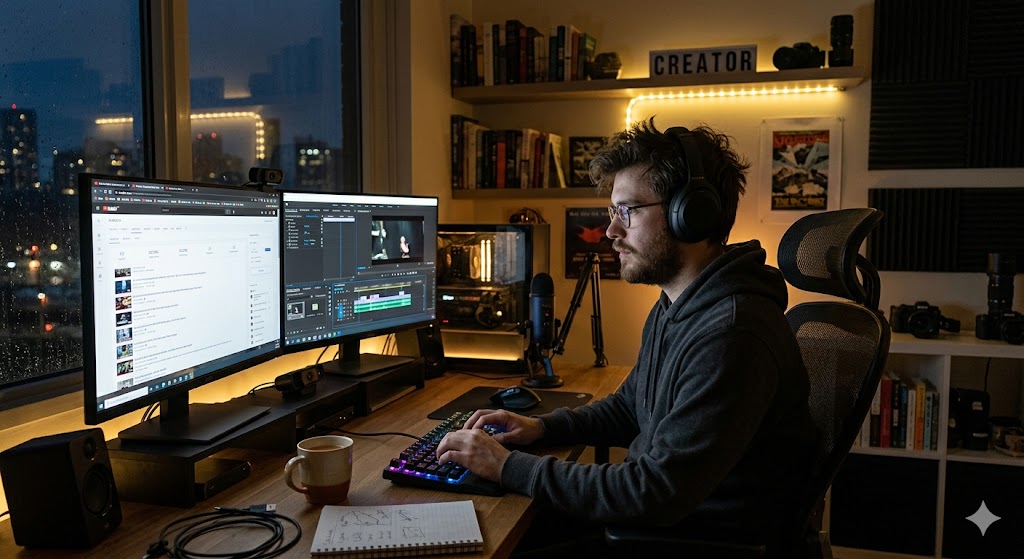
When the view count starts deciding how you feel about yourself
When I started, I assumed views were just a number. A metric. Something you read, act on, and move past.
It took a couple of years to understand what actually happens: the number does not stay on the screen. It walks straight into your mood.
A video takes off and you feel capable. A video stalls and you feel slow. A video gets ignored completely and you start asking a different kind of question:
- Am I actually any good at this?
- Is what I make worth anything?
- Are people rejecting the video, or rejecting me?
That third question is the dangerous one, and there is a reason it shows up. When you upload, you are not uploading a file. You are uploading your taste, your sense of humour, your way of explaining things, your judgement about what matters, and often two weeks of your life.
So when nothing happens, it does not feel like a product missing its market. It feels personal. That is the moment most new creators quietly start to fold.
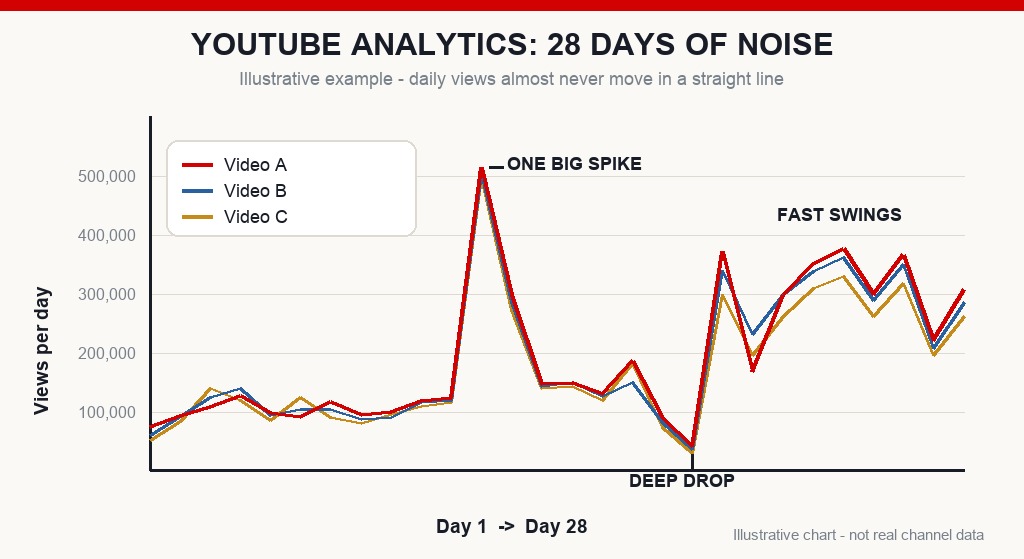
A viral video can lie to you just as loudly
The opposite is just as unreliable, and far fewer people warn you about it.
One video breaks out. Suddenly you feel like you understand the algorithm. You feel like you cracked something. You start planning around the assumption that you can repeat it on demand.
Usually you cannot. Not immediately, anyway.
A breakout video is often a stack of things landing at once: the right topic, the right week, a thumbnail that happened to stand out in that particular sidebar, a viewer group YouTube was already looking for a video to serve. Your skill is part of it. It is rarely all of it.
Which is why the video after a hit is one of the most demoralising uploads in a creator’s life. Lower views. Lower click-through rate. Fewer comments. You go from “I am about to break through” to “maybe that was a fluke” inside a week, and neither sentence is true.
You are a beginner in a league with no beginner division
Here is the structural unfairness nobody explains on day one.
In most crafts, beginners compete with beginners. A new player joins a lower league. A junior designer is judged against other juniors.
On YouTube, your first upload appears in the same feed as channels that have been iterating for eight years. There is no separate lane. Your thumbnail sits next to a thumbnail that was A/B tested nineteen times.
Those channels have things you do not have yet:
- Packaging instincts built from hundreds of uploads
- An existing audience that clicks in the first hour
- Retention data from every mistake they already made
- Storytelling that has been sanded down over years
- A production process that does not collapse under a deadline
Of course they have an advantage. That is not evidence that you are untalented. It is evidence that you are an apprentice in a public arena.
Which means the skill you need first is not editing. It is the ability to hold two things apart in your head: the performance of a video and your worth as a person. A flop means the video did not match a market yet. That is the whole meaning of it.
The tension between making what you love and making what gets watched
Every creator wants a voice of their own. An original angle. Something that is unmistakably theirs.
And then YouTube quietly makes its point: what you most want to make is not automatically what anyone wants to watch.
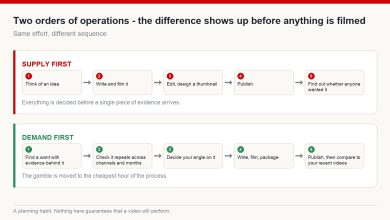
You spend a week on the video you care about. It gets 300 views. Somebody else takes a format that is already working, changes the title, changes the thumbnail, reshoots the same idea, uploads three days later, and it flies.
That stings, and it produces a genuinely hard question. Do you keep making the thing you believe in? Do you make the thing that is proven to work? Is copying a proven format lazy, or is it just how every craft is learned?
This is a real conflict, not a fake one. Creativity pulls one way. Growth pulls the other. Identity pulls one way. The algorithm pulls the other.
Borrowing is normal. Copying on autopilot is the problem.
Let me be blunt about this, because pretending otherwise helps nobody.
Nobody on this platform invented their approach from nothing. Every creator learned hooks from other creators. Learned pacing from other creators. Learned title structure, thumbnail contrast, and how to open a video, all from watching people who were further ahead.
The question is not whether you study other channels. The question is whether you are copying unconsciously or studying deliberately.
Copying unconsciously looks like: same title, same structure, same thumbnail composition, same script beats, a few details swapped.
Studying deliberately looks like asking:
- Why is that title strong? What tension does it create?
- Where exactly does the thumbnail create curiosity?
- What does the first fifteen seconds promise, and how?
- Which specific frustration is this topic sitting on?
- What did this video leave out that I could do properly?
Once you can answer those, you are not riding someone else’s idea. You are building your own judgement on top of evidence. That is a permanent skill, and it is the difference between a channel that lasts and a channel that gets caught by YouTube’s reused-content rules.
The people in the room stop getting the real you
This is the part most creators avoid saying out loud.
Channel work is unusually absorbing. You start by learning to record. Then editing. Then thumbnails. Then search. Then retention graphs. Then AI tools. Then how to produce more without dropping quality. Every skill opens onto another one, and none of them ever feels finished.
At some point it stops being something you do and becomes something running in the background of your head all day.
You are at dinner, thinking about a title. You are out with friends, rewriting an intro in your head. Someone is telling you about their week and you are estimating whether your click-through rate has moved.
You are physically present. Mentally, you left an hour ago.
The people close to you feel that long before you notice it. They ask you something and get back “yeah”, “later”, “I know”. You are not trying to be cold. But from the other side of the table, the message is clear enough: you are not really here.
Do that for a year and the people who love you start feeling lonely while sitting next to you.
Deep focus is your biggest edge and your biggest trap
Most creators who get good have one thing in common: they can disappear into a task for hours. That is a genuine advantage. Nobody makes a strong video in twenty-minute fragments.
But the same wiring has a cost. In deep-focus mode you stop registering the room. You do not notice that someone needed you. You do not notice that you have not had a real conversation in four days. You tell yourself you are investing in the future.
Sometimes you are. Sometimes what you are spending is the relationships that were supposed to be there when the channel worked.
The Studio refresh loop
There is a behaviour almost every creator recognises.
Open Studio. Check views. Close it. Open it again. Refresh. Check realtime. Check comments. Check the revenue estimate. Check click-through rate. Check retention. Close the app. Open it again five minutes later.
It sounds ridiculous written down. It is also extremely common.
YouTube Studio is built the way slot machines and trading apps are built. The number moves on its own schedule, and you never know when the next good signal arrives. A new comment. A jump in realtime. Some sign that the video is about to be pushed. Each small increase gives you a small chemical reward, which is exactly why you go back.
The uncomfortable truth: watching the graph does not move the graph. It only drains you.
New creators do not need minute-by-minute data
Analytics matter enormously. Checking them constantly, in your first year, usually does more harm than good.
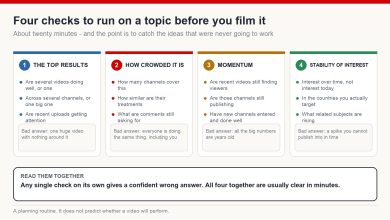
The reason is simple: you do not have enough data to read yet. Not enough videos to compare against. No sense of what a normal curve looks like on your channel. No basis for deciding whether a low click-through rate at hour one means anything at all.
So you panic. You swap the thumbnail after 30 minutes. An hour later you change the title. The next day you change something else. Now you have four variables moving at once and you have learned nothing about any of them.
YouTube needs time to test a video against different audiences. You need enough patience to let that test finish.
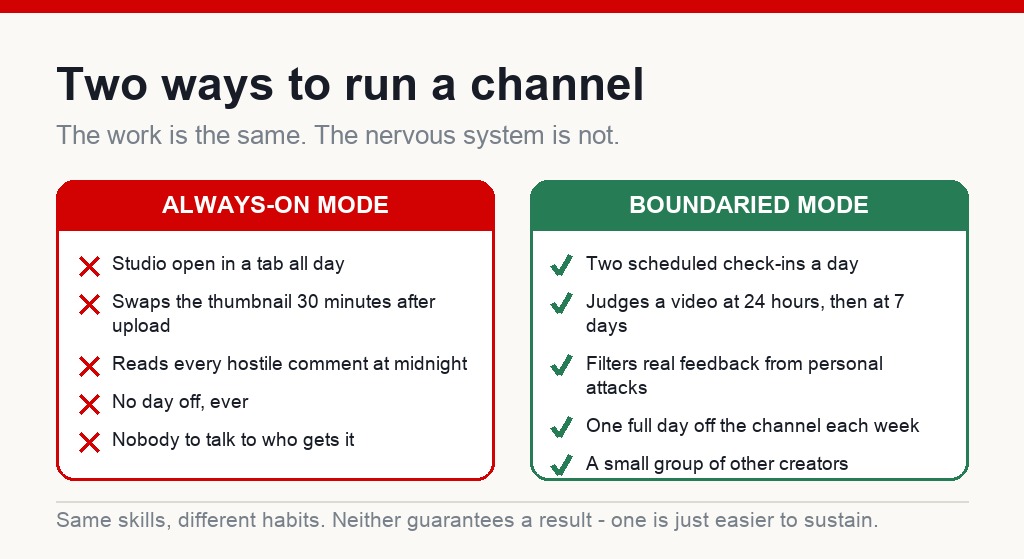
A schedule that works better:
- One check in the morning, one in the evening
- A first rough read at 24 hours
- A serious read at 7 days
- Pattern conclusions only across ten or more videos
You are a creator, not a night watchman for a realtime graph.
Working alone at home is lonelier than it sounds
On paper it is ideal. No commute. No timesheet. No meetings. Nobody assigning you work.
In practice there are weeks where you barely leave the building. Laptop open at nine. Lunch eaten standing up. Editing all afternoon. Scripting in the evening. Analytics at midnight.
Most of your communication is typed. You see friends rarely. You see daylight less than you should. Your body barely moves.
You think of it as independence. It can quietly become confinement, and the worst part is how quickly it becomes normal.
The loneliness that is harder to fix
Physical isolation is tiring. Being misunderstood by the people around you is heavier.
Your family may love you and still have no framework for what you do. You explain a video idea and get a polite nod. You are stressed about a retention drop and it reads to them as being upset about a website. You get a cruel comment and they say, reasonably, “just ignore it”.
They are right. It is also not that simple, because the comment is aimed at work you did, and often at your voice, your face, or the way you think.
When nobody around you can name what you are feeling, you end up chewing on it alone. That is why plenty of creators look completely fine and are running on empty.
Hostile comments cost more sleep than they should
One kind message can carry you through a day. One cruel one can take a night.
This hits hardest early, before you have built any calluses, before you can separate a real critique from someone having a bad afternoon.
Three lines from a stranger are enough to make you doubt a month of work. And the cruel irony is that you still have to sit down and create the next thing with those lines running in your head.
Two habits help more than any mindset advice. First, decide in advance which comments you owe a response to: specific, actionable feedback, and nothing else. Second, read comments at a fixed time of day, never last thing at night.
How to protect yourself while you build
I do not think creators need to be tougher in the “absorb everything” sense. You are not a content machine. You are a person, and people need limits to keep working.
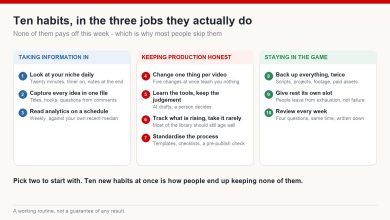
1. Stop using views as a verdict on yourself
A flop is a signal, not a sentence. It usually means the topic was off, the thumbnail was unclear, the opening was weak, the audience was mismatched, or YouTube simply has not found the right viewers yet. Read it as data you can act on. Do not read it as an assessment of you.
2. Put Studio on a schedule
Twice a day is enough. When you open it, write down one thing you learned, then close the tab. Do not scroll analytics the way you scroll a feed. It is an instrument, not a place to look for reassurance.
3. Take a real day off
This sounds easy and is not, because there is always a background feeling that you are falling behind. Not uploading feels like lost momentum. Not studying feels like other people pulling ahead.
Rest does not make you weaker. It is what makes year three possible. Every production system needs maintenance time, and you are part of the system.
4. Tell the people close to you what is actually happening
You do not need them to understand the algorithm. You do need them to know that metrics can put you in a bad mood, that a hostile comment can land harder than it should, and that when you go quiet you are not withdrawing from them on purpose.
People handle what they can name. So can you.
5. Find a few creators on the same road
Someone outside this work will struggle to understand why a retention graph ruined your morning. Another creator gets it in one sentence.
They know the feeling of watching realtime after an upload. They know what a dead thumbnail does to you. They know what it is to lose three days to a video that goes nowhere. A small, honest group of peers prevents a surprising number of bad nights.
Do not let the channel eat the person
Building on YouTube can give you real things. Control over your time. Skills that transfer. A body of work that keeps earning attention after you made it.
Handled carelessly, it can also take real things. Your sleep. Your patience. Your relationships. Your sense of being a person rather than a set of metrics.
So take the work seriously. Just do not let it define you. You can want growth, want the income, want the breakout video, and still be someone who closes the laptop and has a life waiting on the other side of it. That life needs more than a graph that is currently moving.
Creators need recovery too
Behind every upload there is a person with expectations, fear, pressure, and days where they would rather not exist on the internet at all.
If you are building a channel right now and you are tired, you are not unusual. A large share of the people whose numbers you envy have been exactly there. They just do not post about it.
You are not your view count. You are not your click-through rate. You are not your revenue per thousand views. You are not one video that failed.
You are someone learning a hard craft in public: testing, getting it wrong, correcting, and improving. If you can keep your head straight, keep the people who matter close, and keep your own voice while you learn how the machine works, that is already a serious result.
Frequently asked questions
Is YouTube creator burnout actually common?
Yes. It is common precisely because the feedback is public, constant and numerical. When your mood is tied to views, comments, click-through rate and revenue, exhaustion builds quietly. Separating the metrics from your self-assessment is the main defence.
Why is YouTube Studio so addictive?
It updates continuously and unpredictably, the same structure that makes feeds and trading apps hard to put down. Because you never know when a positive signal will appear, refreshing feels rational even when it changes nothing.
Does a video flopping mean I am not good at this?
No. A flop points at a mismatch in the topic, the thumbnail, the title, the opening, the audience or the timing. It is information about one video, not a measurement of your ability.
Should I copy formats that are already going viral?
Learn from them, do not clone them. Work out why the video held attention, then bring your own angle, examples and delivery. Mechanical copying tends to produce weak retention and can run into YouTube’s reused-content policies.
How do I stop hostile comments from getting to me?
Separate critique from attacks. Critique is worth reading and acting on. Personal attacks can be hidden, deleted or ignored. Read comments at a set time, and never as the last thing you do before sleep.
How often should a new creator check analytics?
One or two scheduled check-ins a day is plenty. Minute-by-minute monitoring rarely improves decisions in the first year, because you do not yet have enough videos to tell a signal from noise. Results vary from channel to channel, and YouTube’s own systems change, so treat any single reading with caution.
If you are building a channel for an international audience, learn the production skills and the emotional ones in parallel. A step-by-step programme for building a faceless channel aimed at English-speaking viewers is available at mmoyoutube.com.